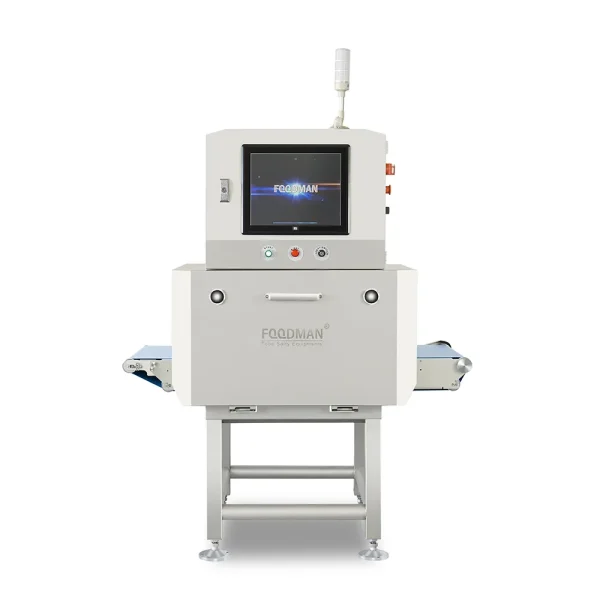
Food products can contain foreign materials that are impossible to identify from the outside. Glass, stones, metal, bones, ceramics, and some plastics may remain hidden inside food or packaging. Visual inspection cannot reliably examine these internal areas, creating a need for a method that can look beneath the product surface.
X-ray inspection addresses this problem by using differences in material density to create images of products as they move through a production line. The resulting images are analyzed to identify unwanted objects or abnormalities. Understanding this sequence explains why food X-ray inspection equipment can perform quality checks without opening packages or stopping production.
From X-Ray Beam to Internal Product Image
The process begins when an X-ray source produces a controlled beam directed toward products moving through the inspection area. Rather than simply photographing the external surface, the beam passes through the food and packaging. Different materials absorb X-ray energy at different rates according to their density and composition.
A sensor positioned after the product captures the X-ray energy that remains after penetration. The resulting information is converted into an image showing variations within the inspected item. Areas with substantially different density from the surrounding product can therefore become visible to the inspection system.
That principle gives X-ray technology an important role in food processing. A contaminant does not have to be visible from the outside to be detected. Easyweigh describes its systems as using density differences to identify foreign objects including metal, glass, stones, ceramics, and certain plastics.
Image quality matters because the system must distinguish a potential contaminant from normal variations in the food itself. High-resolution imaging and suitable processing technology can provide more information for the detection stage, particularly when products have complicated internal structures.
How the System Turns Image Data Into an Inspection Decision
Capturing an image is only one part of the process. Inspection software must interpret the image and determine whether the observed pattern corresponds to an acceptable product or a possible defect.
Detection algorithms examine differences within the image and compare them against configured inspection criteria. A dense foreign object may appear as a distinct feature against the surrounding food. The system can then classify the product according to the programmed inspection conditions.
Modern food X-ray inspection equipment can combine imaging with advanced image-processing functions. Easyweigh’s Foodman systems use Foodman Intelligent Algorithm Platform (FIAP) image processing, while its product range also includes solutions using AI-related image analysis and Time‑Delay Integration (TDI) technology for high-resolution inspection.
The software stage is especially important for reducing unnecessary rejects. Food naturally varies in shape, thickness, and density. A practical inspection system therefore needs to distinguish normal product variation from an abnormal object rather than treating every image difference as contamination.
Inspection criteria also depend on the product being examined. A packaged snack, fish product, canned food, and liquid sauce do not present the same image characteristics. Product-specific setup is therefore part of making the detection process useful in real production.
Why Product Format Changes the Inspection Method
Food processing rarely involves one universal product format. Loose materials may move along a conveyor before packaging, while finished products may pass through the system inside bags, cartons, cans, or other containers.
Packaged products can be inspected after sealing, allowing manufacturers to examine the contents without opening the package. Easyweigh lists applications including biscuits, potato chips, infant food, seasonings, meat products, poultry, sausages, and other packaged foods for its packaged-product X-ray system.
Bulk products require equipment designed around continuous material flow. The inspection geometry and rejection method must account for products that may spread across a conveyor rather than travel as individual packages. Easyweigh’s range includes a system specifically designed for loose and unpackaged food products.
Liquid and semi-solid products create another inspection scenario. Pipeline systems can inspect products such as sauces, jams, soups, and minced meat while they move through pipes. In this configuration, the X-ray inspection process becomes part of the continuous processing route rather than a conventional conveyor inspection point.
What Happens After an Abnormality Is Detected
Detection only creates value when the production line can respond appropriately. Once software identifies a product that does not meet the inspection criteria, the system can communicate with an automatic rejection mechanism.
The rejection method depends on the product and production arrangement. Packaged products may be pushed or diverted from the main conveyor, while other systems require a different removal mechanism. The objective remains the same: prevent a suspect product from continuing toward packaging, storage, or shipment.
Line placement also affects the overall workflow. X-ray inspection can be positioned at different points, including raw-material handling, processing stages, pre-packaging, post-packaging, or final-product inspection. The most useful location depends on where the manufacturer can control the relevant risk most effectively.
Easyweigh offers inspection configurations for different product formats, including packaged goods, bulk products, vertical packaging, and pipeline applications. This range allows manufacturers to consider the inspection point as part of the wider production process rather than treating the X-ray machine as an isolated device.
Making X-Ray Inspection Work Consistently on the Factory Floor
Reliable inspection depends on the relationship between the equipment and the production environment. Product positioning, conveyor movement, packaging configuration, inspection settings, and cleaning conditions can all influence how consistently images are produced.
Stable product presentation makes image analysis easier. Irregular spacing, overlapping products, or major changes in product orientation can create more complicated inspection conditions. Manufacturers should therefore evaluate the actual production flow when determining equipment configuration.
Environmental requirements also deserve attention. Food-processing equipment may face moisture and frequent cleaning. For example, Easyweigh lists IP66 protection for the tunnel of its dual-beam side-scan system and IP69 protection for its pipeline system, reflecting different operating environments and equipment designs.
Operator training and routine maintenance complete the process. Correct setup helps maintain inspection consistency, while regular checks can identify equipment or process changes before they affect production. Easyweigh also states that it provides training and maintenance support for its inspection systems.
Understanding how X-ray inspection works makes equipment selection more practical. The technology is not simply a camera placed over a conveyor; it is a sequence involving X-ray penetration, image capture, software analysis, and production response. When those stages are matched to the product and workflow, food X-ray inspection equipment can become an integrated part of food quality control.
For manufacturers evaluating inspection technology, Easyweigh provides configurations designed for different food-processing formats and production requirements. As an original equipment manufacturer, Easyweigh delivers both standard‑specification machines and custom OEM / ODM solutions to adapt equipment for unique line layouts and special processing requirements. Prospective buyers can submit real product samples for professional performance testing before final procurement decisions. The appropriate solution depends on the product, packaging, inspection position, and operating environment rather than on one universal machine specification.
Ultimately, food X-ray inspection equipment works by making internal product information measurable and actionable. That ability gives food processors another layer of control over foreign-object detection while allowing inspection to take place within continuous manufacturing operations.
