Commercial spaces increasingly use artificial trees to create distinctive interiors, reinforce seasonal themes, and maintain a consistent visual identity. For retailers, hotels, restaurants, and commercial design firms, customization involves more than appearance. Tree dimensions, foliage colors, trunk finishes, pot styles, order quantities, and delivery schedules all influence how well a product fits a project. Choosing the right manufacturing partner helps buyers balance design requirements, purchasing costs, and supply consistency.
Why Customization Matters for Commercial Projects
A standard decorative tree may suit a small retail display but fail to meet the requirements of a hotel lobby or coordinated store rollout. Commercial projects often involve specific ceiling heights, floor layouts, brand colors, and customer circulation areas. Customized artificial trees can address these requirements more precisely than products selected solely from standard catalogs.
Working with experienced artificial tree manufacturers also gives buyers greater control over product specifications before production begins. For wholesalers, retailers, and interior contractors, this can simplify purchasing across multiple locations and help maintain a consistent appearance throughout a commercial space.
Key Customization Options for Artificial Trees
- Tree Height, Shape, and Branch Structure
Dimensions should be among the first considerations. Buyers need to evaluate ceiling clearance, available floor space, viewing angles, and the relationship between the tree and surrounding furniture or displays. A tree that looks impressive in a product photograph may overwhelm a narrow storefront or obstruct a restaurant’s seating area.
Customization can include overall height, canopy width, branch placement, and foliage density. These details influence visual impact and practical placement. For multi-site projects, agreeing on dimensional tolerances and a reference sample before mass production can reduce inconsistencies between batches.
- Foliage Colors and Trunk Finishes
Color and texture help artificial trees support a project’s intended atmosphere. Green foliage may suit permanent interior decoration, while amber, rust-orange, and golden leaves can create a seasonal autumn display. Trunk finishes also matter because realistic surface textures can make decorative trees look more convincing at close range.
Buyers should communicate their preferred colors through reference images, physical samples, or approved design files. This is particularly useful when the greenery needs to coordinate with branded interiors, seasonal campaigns, or a standardized visual merchandising plan.
- Materials, Pots, and Functional Requirements
Material selection affects appearance, handling, and suitability for different environments. Buyers should confirm the foliage material, trunk construction, pot dimensions, and base stability rather than relying on general descriptions such as “lifelike” or “durable.”
For projects in public or outdoor-facing spaces, additional requirements may apply. Fire performance, ultraviolet resistance, and other relevant specifications should be confirmed for the exact product and intended installation. Buyers should request appropriate test documentation where required and avoid assuming that every artificial tree automatically meets local building or fire-safety standards.
Pot selection deserves similar attention. A nursery pot may work for straightforward placement, while a decorative planter may better match a premium hospitality or retail interior. Confirming the base dimensions and installation method in advance helps prevent avoidable site adjustments.
Evaluating Artificial Tree Manufacturers for OEM and ODM Orders
Customization is most effective when the manufacturer can translate a design brief into repeatable production specifications. Before placing an order, business buyers should assess design support, manufacturing capabilities, sample approval procedures, quality control, and export experience. These factors are especially important when a project requires large quantities or recurring seasonal replenishment.
An OEM arrangement can help buyers produce trees according to their own specifications, while ODM services may offer an existing design that can be adapted to their needs. Factory-based production can also simplify communication between design, processing, manufacturing, and export teams.
Price should be assessed alongside these capabilities. A competitive unit price does not necessarily represent the lowest overall project cost if packaging, shipping volume, quality discrepancies, or rework create additional expenses. Buyers should compare quotations against the same specifications, order quantities, packaging requirements, and delivery terms.
Samples, Lead Times, and Bulk Production
Sampling allows project teams to assess color, texture, construction, and overall proportions before committing to bulk production. Buyers should agree on the approval process, confirm which specifications will remain fixed, and establish how changes will be handled after sample approval.
Lead times also need careful planning, particularly for seasonal campaigns. Autumn displays, for example, should be ordered early enough to accommodate sampling, production, shipping, and installation. Artificial tree manufacturers may offer different schedules depending on customization complexity, material availability, and order volume, so buyers should obtain a project-specific production timeline rather than assume every order follows the same schedule.
A Practical Example: The 180cm Artificial Fall Oak Tree
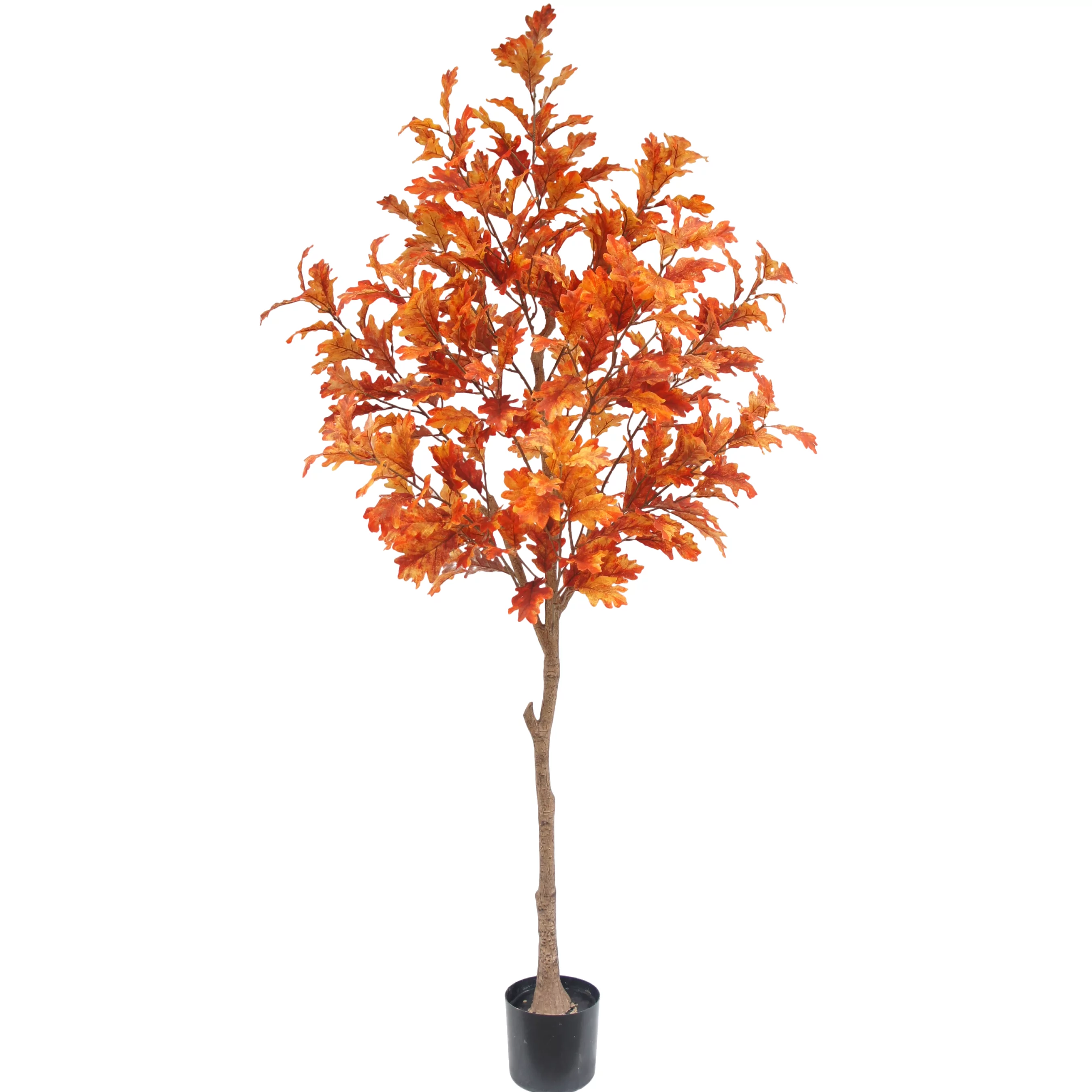
The 180cm Artificial Fall Oak Tree for Autumn Decor illustrates how a defined product specification can support seasonal commercial projects. Its rust-orange, amber, and deep-gold lobed leaves create an autumnal focal point, while the detailed woody trunk adds natural texture. The stable black nursery pot provides a practical base for placement in suitable retail and hospitality settings.
The tree stands 180cm tall and features silk orange oak leaves, a detailed woody trunk, and a stable black nursery pot. Its minimum order quantity is 200 pieces. The stated sample lead time is 7–10 days, while production takes 15–45 days, depending on the order requirements and applicable production arrangements.
The product can suit retail window displays, restaurant seasonal updates, and themed hospitality decorations. Its artificial foliage avoids the routine watering and fallen-leaf cleanup associated with live seasonal plants, although regular dusting and appropriate handling remain necessary. For buyers planning a rollout across multiple locations, the stated minimum order quantity and production schedule provide a starting point for procurement planning.
Before confirming a bulk order, buyers should verify the final color, dimensions, packaging, and delivery schedule. Any requirements for alternative pot finishes or modified designs should be agreed upon in writing.
Turning Custom Designs into Reliable Supply
Successful commercial projects depend on aligning design expectations with manufacturing capabilities, realistic lead times, and clear purchasing specifications. Buyers who define these requirements early can make better comparisons between suppliers and reduce the risk of costly adjustments after production begins. Reviewing samples and confirming quality expectations are equally important when ordering for multiple locations.
Sharetrade is a fake plants manufacturer offering OEM and ODM solutions covering design, manufacturing, processing, and exportation. Its factory-based production supports customized designs and bulk orders for business projects. For businesses evaluating artificial tree manufacturers, Sharetrade offers a potential partner for coordinating product requirements and larger purchasing programs. Contact Sharetrade to discuss your project specifications, request a tailored quotation, and explore customization options for your next commercial order.
