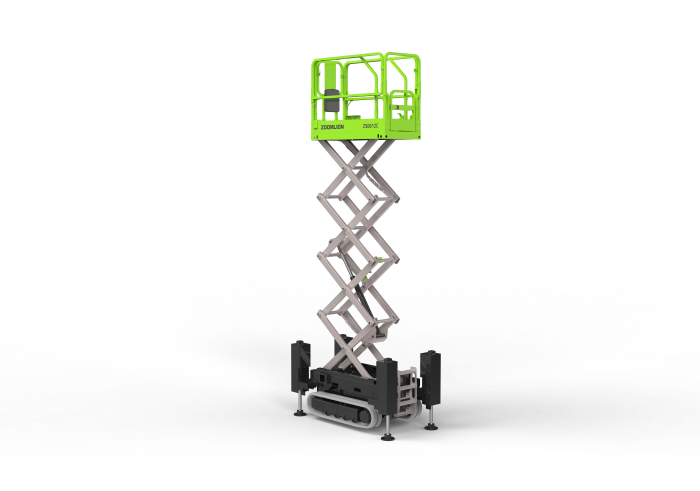
Transport planning is an important part of equipment deployment, especially when a crawler scissor lift must be delivered to a construction or maintenance site. Loading and unloading involve more than putting a machine onto a trailer. Teams need to consider machine weight, dimensions, ramp suitability, ground conditions, traffic separation, securing arrangements, and operator responsibilities before the delivery vehicle arrives.
Confirm the Transport and Site Conditions
Before dispatch, the carrier and receiving team should confirm that the trailer or transport vehicle is suitable for the machine’s dimensions and weight. The receiving area should provide enough space for the vehicle, ramps, and machine to maneuver without creating unnecessary conflicts with pedestrians, other equipment, or site traffic.
IPAF recommends planning MEWP loading and unloading in advance and ensuring the transport vehicle is compatible with the equipment. It also advises using a designated area with firm, level ground, adequate lighting, and separation from other site activities where possible.
Measure the Delivery Route First
A delivery plan should cover the complete route from the site entrance to the unloading point. Check gate widths, overhead clearances, turning areas, road gradients, surface conditions, and temporary restrictions. A route that is suitable for the truck may still create difficulties when the track scissor lift leaves the trailer and moves toward its operating location.
Site teams should also verify the unloading zone itself. IPAF recommends avoiding loading and unloading on public highways wherever possible and providing an area that is sufficiently large, well lit, firm, level, and clear of traffic and pedestrians. Underground and overhead hazards should also be considered before work begins.
Check Ramp and Ground Conditions
Ramp selection is critical when moving tracked equipment from a transport deck to the ground. The ramp must be appropriate for the machine, vehicle, and intended loading configuration. Weight distribution, ramp width, surface condition, and the transition between the trailer bed and ramp should all be checked before movement starts.
The ground beside the trailer also matters. Soft soil, standing water, loose aggregate, steep gradients, or uneven transitions can affect machine movement during unloading. IPAF highlights tip-over risks when loading MEWPs and notes that ramps should be adjusted according to the machine being loaded.
Manage Machine Orientation Carefully
Tracked machines can have different drive characteristics depending on their orientation. Operators should identify the machine’s drive-direction indicators and understand how the controls respond before approaching the ramps. IPAF specifically recommends confirming drive orientation throughout loading and unloading because incorrect direction can contribute to collisions or loss of control.
The unloading sequence should also keep people outside the machine’s path. A spotter or banksman may be appropriate where visibility is restricted or the layout is complex. Recent IPAF guidance notes that pedestrian-control operations can introduce additional risks and recommends planning, adequate lighting, segregation, and clear communication.
Secure the Machine for Transport
Loading is only one part of the process. Once a machine is positioned on the transport vehicle, it needs to be secured according to the applicable transport requirements and the manufacturer’s instructions. The securing method should account for the machine’s weight, dimensions, attachment configuration, and the characteristics of the transport vehicle.
Before departure, the delivery team should verify that the machine is correctly positioned, secured, and protected from unintended movement. The receiving team should then inspect the load before unloading begins. Any visible transport damage, loose components, or unusual conditions should be addressed before the machine is operated.
Plan for Weather and Visibility
Weather can affect both loading and unloading conditions. Rain may reduce traction on ramps or create slippery surfaces, while poor visibility can make it harder for operators and spotters to judge distances. Wind, darkness, and changing ground conditions should be considered as part of the site-specific risk assessment.
IPAF’s current guidance also identifies poor weather and darkness as circumstances that can influence unloading arrangements and notes that a winch may sometimes be appropriate where machine gradeability, conditions, or a company’s safe system of work require it.
The ZS0612C From Zoomlion Access
The ZS0612C from Zoomlion Access is a crawler scissor lift with a maximum working height of 7.8 m and a platform capacity of 230 kg. Its published gross weight is 1,900 kg. The overall dimensions are 2.19 m in length and 1.15 m in width, while overall height is 2.27 m with rails raised and 1.88 m with rails lowered.
These figures give transport planners concrete dimensions to check against trailer capacity, loading space, site entrances, and unloading areas. The machine has 0.08 m ground clearance and a 30% gradeability, equivalent to 17°, while its maximum working slope is listed as 12° lateral and 7° vertical. Those operating specifications should not be treated as an automatic approval for any particular loading ramp; the transport setup still needs to follow manufacturer instructions and a site-specific assessment.
Features Relevant to Delivery Planning
The ZS0612C uses four 12V/240Ah batteries and a 24V/30A charger. Its published drive system uses two 24V/2 kW motors. The machine’s stowed drive speed is 2 km/h, while the raised drive speed is listed as 0 km/h. This means delivery teams should plan unloading around controlled ground travel after the machine has safely left the transport vehicle.
Zoomlion Access states that the ZS0612C uses rubber crawlers designed to reduce ground pressure and provide obstacle-crossing capability. Their published information also identifies the model as CE certified. For delivery planning, these characteristics should be considered together with the machine’s weight, dimensions, slope ratings, and the actual surface where unloading will take place.
Why Work With Zoomlion Access
Zoomlion Access offers crawler scissor lifts alongside other scissor-lift configurations, including AC, lithium-ion, high-altitude, heavy-duty, and electric rough-terrain models. Their current crawler range includes the ZS0508C, ZS0610C, ZS0612C, and ZS1216C, providing different working-height and platform-capacity options within the category.
For contractors and rental companies, Zoomlion Access can therefore be considered as part of a broader powered-access procurement strategy. The key delivery principle remains consistent: verify the transport vehicle, loading area, ramp arrangement, unloading route, ground conditions, and safety controls before the machine arrives. With the ZS0612C’s published dimensions and 1,900 kg weight available in advance, teams can prepare the delivery process around measurable equipment requirements.
