Aluminium sand casting offers considerable flexibility for producing complex metal components, particularly when part geometry, internal cavities, or development requirements make other processes less suitable. However, casting quality depends on much more than the aluminium alloy itself. Sand condition, mold preparation, core design, gating, pouring, and solidification all influence the final result.
Understanding common aluminium casting defects from a process perspective makes it easier to identify problems at their source rather than relying on costly rework after casting. For manufacturers, effective defect prevention begins before molten aluminium enters the mold.
Why Do Aluminium Casting Defects Occur in Sand Casting?
Sand casting creates a temporary mold around the required part geometry. This flexibility also introduces several variables that must be controlled carefully. Incorrect sand moisture can generate excessive gas, inadequate permeability can prevent gases from escaping, and insufficient mold or core strength can cause dimensional or surface problems.
The pouring stage introduces another group of risks. Aluminium that is poured too cold may solidify before the cavity is completely filled, while excessive turbulence can increase gas entrapment and oxide formation. During solidification, uneven cooling and insufficient feeding can produce shrinkage-related defects.
As a result, aluminium casting defects are often interconnected. A problem that appears on the finished casting may originate several stages earlier in the process.
Common Aluminium Sand Casting Defects
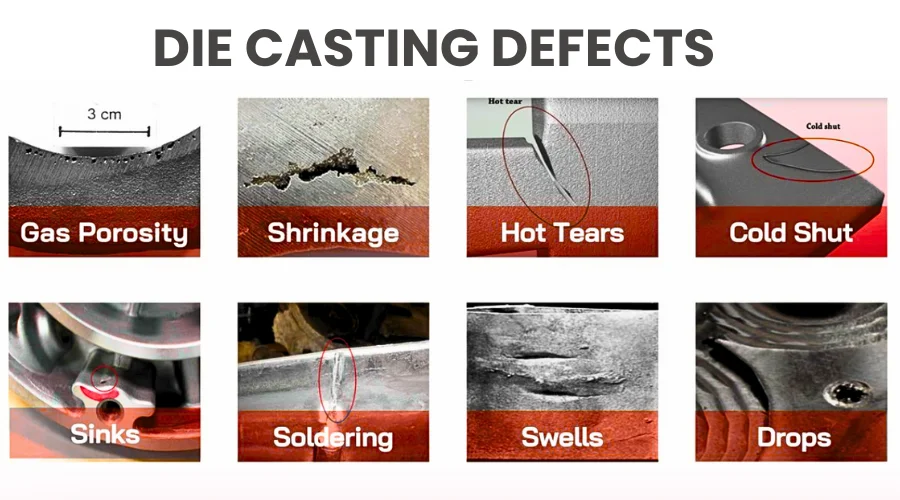
Gas Porosity and Blowholes: Gas porosity appears as small internal voids, while larger gas-related cavities may develop as blowholes. In sand casting, moisture in the molding material can generate water vapor when exposed to molten aluminium. Poor permeability or inadequate venting can then prevent the gas from escaping. Controlling moisture, maintaining suitable sand permeability, improving venting, and minimizing turbulent metal flow are important measures for reducing these defects.
Shrinkage Cavities: Aluminium contracts as it cools from the liquid state to a solid. If the casting cannot receive sufficient molten metal during solidification, internal shrinkage cavities or shrinkage porosity may form, particularly around thicker sections. Proper riser placement, suitable feeding paths, consistent wall thickness, and thoughtful gating design can help direct solidification and provide adequate metal feeding.
Sand Inclusions: Sand inclusions occur when mold or core material becomes detached and is carried into the molten metal. Weak molds, excessive erosion, poor handling, or unsuitable sand properties can contribute to this problem. Controlling mold strength and permeability while carefully preparing the mold and core helps protect the casting surface and internal structure.
Misruns and Cold Shuts: A misrun occurs when molten aluminium fails to completely fill the mold before solidifying. A cold shut forms when separate streams of metal meet but do not fuse properly. Low pouring temperature, insufficient fluidity, poor gating, excessive heat loss, or unsuitable section thickness can contribute to these defects. Improving metal temperature control and designing an efficient filling path can reduce the risk.
Hot Tears: Hot tears are cracks that develop during the final stages of solidification when the metal is unable to contract freely. They are more likely in areas where the casting geometry creates strong restrictions against shrinkage. Reducing abrupt section changes, improving mold and core configuration, and managing solidification behavior can help minimize hot tearing.
Mold Shift and Core Shift: Mold shift occurs when the two mold halves are incorrectly aligned, while core shift can move internal cavities away from their intended position. These problems can produce dimensional inaccuracies and uneven wall thickness. Accurate pattern and core positioning, secure mold assembly, and dimensional verification are essential for controlling these defects.
Scabs and Veining: Scabs appear when portions of the mold surface break away and become attached to the casting. Veining can occur when the sand mold develops surface cracks as it responds to thermal expansion. Appropriate sand properties, mold strength, binder control, and mold preparation can reduce the likelihood of these surface defects.
How Sand Moisture and Permeability Affect Casting Quality
Sand is not simply a container for molten aluminium. Its moisture content and permeability directly influence how gases behave during pouring and solidification.
Excessive moisture can increase gas generation, while insufficient permeability can restrict gas evacuation. At the other extreme, poor sand bonding or inadequate strength may increase erosion and inclusion risks.
Consistent sand preparation therefore provides an important foundation for controlling aluminium casting defects. The appropriate balance depends on the molding system, alloy, casting geometry, and production conditions.
How Mold and Core Strength Influence Defects
The mold and core must maintain their shape when exposed to the temperature and pressure of molten aluminium. Weak or improperly prepared molding materials can erode, deform, or crack during casting.
Core quality is especially important for components with internal passages. A core that shifts or breaks can affect both dimensional accuracy and internal surface quality. Reviewing core geometry, support, draft, venting, and positioning during design can prevent problems before production begins.
How Gating System Design Reduces Sand Casting Defects
The gating system determines how molten aluminium enters and moves through the cavity. Poorly designed gates and runners can create turbulence, premature solidification, air entrapment, and uneven filling.
A well-considered system should provide controlled metal flow while reducing unnecessary turbulence and supporting directional solidification. Gate location, runner dimensions, sprue design, and riser positioning should therefore be evaluated together rather than independently.
How Pouring Temperature Affects Aluminium Sand Castings
Pouring temperature directly affects aluminium fluidity and solidification behavior. If the metal temperature is too low, the alloy may lose fluidity before the cavity is filled. Excessive temperature, however, can increase oxidation and may affect mold degradation.
The appropriate range depends on the alloy, casting size, wall thickness, mold condition, and production method. Consistent temperature monitoring is more valuable than simply selecting a higher temperature to compensate for poor filling.
How to Inspect Aluminium Sand Castings
Visual Inspection: Visual inspection can identify obvious cracks, surface inclusions, scabs, misruns, cold shuts, and other surface abnormalities. It provides an efficient first-stage assessment before more detailed testing.
Dimensional Inspection: Critical dimensions, wall thicknesses, hole locations, and internal geometry should be checked against the drawing or CAD model. Dimensional inspection can reveal mold shift, core shift, and solidification-related distortion.
Radiography: Radiographic inspection can reveal internal discontinuities that cannot be identified from the external surface, including certain forms of porosity, inclusions, and shrinkage cavities. It is particularly useful when internal integrity is important to part performance.
Metallographic Examination: For more detailed failure analysis, metallographic examination can help evaluate the internal microstructure and identify characteristics associated with porosity, inclusions, or solidification behavior.
Design Considerations for Defect Prevention: Defect prevention should begin with the part design rather than after the first casting is produced. Excessively thick sections can increase shrinkage risks, while abrupt changes in wall thickness can create uneven cooling. Difficult-to-fill regions may also require changes to the gating strategy.
At HordRT, engineering review is incorporated into the manufacturing process. The company supports projects from design review and rapid tooling through production and quality inspection, allowing manufacturing considerations to be addressed before production begins. Its broader capabilities include die casting, CNC machining, rapid tooling, and other processes.
A Practical Approach to Preventing Aluminium Casting Defects
Reliable sand castings come from controlling the complete process rather than correcting defects one by one. The condition of the sand affects mold performance. Mold and core preparation influence cavity accuracy and gas evacuation. Gating controls metal flow, while pouring temperature affects filling. Solidification determines whether shrinkage and hot tearing develop. Inspection then verifies whether the finished casting meets the required specifications.
HordRT combines engineering review, manufacturing, and quality inspection within an integrated production workflow. Its current manufacturing operation includes two facilities and supports projects from prototypes through production, with process selection based on material, quantity, tolerance, and delivery requirements.
For projects where casting quality, dimensional consistency, and production efficiency must be considered together, this integrated approach can help identify potential manufacturing risks earlier and reduce unnecessary iterations. With experience across multiple manufacturing processes and dedicated engineering support, HordRT provides a practical path from casting design to production-ready components.
