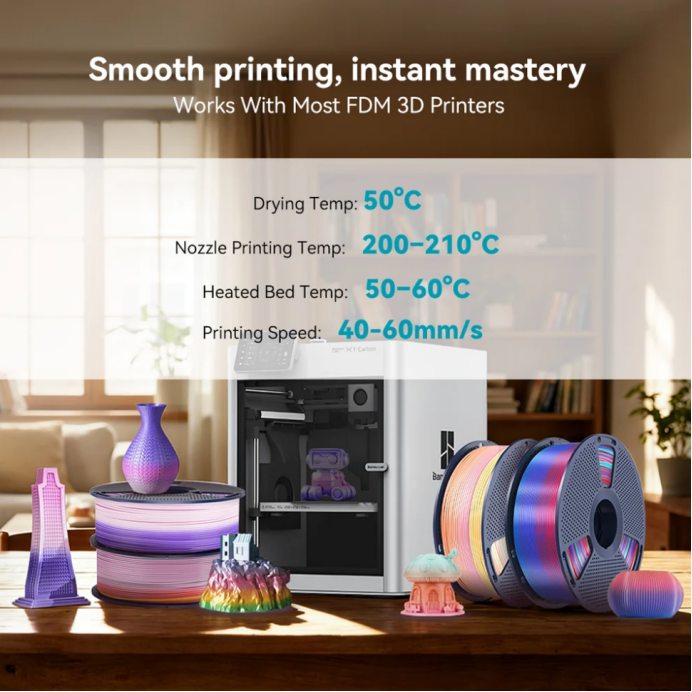
Silk PLA presents a significantly less demanding printing workflow than Silk PETG on standard desktop machines. The lower thermal processing window of PLA naturally reduces the risk of catastrophic calibration errors. While both polymers yield an attractive, glossy surface, Silk PETG introduces severe mechanical hurdles related to chemical adhesion and melt viscosity. Evaluating these physical differences directly highlights why Silk PLA is the far more accessible choice for visual projects.
Build Plate Interaction and Part Removal Mechanics
The initial point of friction for any print begins at the build plate. Silk PLA melts efficiently at moderate temperatures, bonding predictably to standard PEI sheets or textured glass surfaces. Once the plate cools down to room temperature, the printed part releases with minimal physical effort. This gentle release is crucial because it protects the delicate, reflective bottom layers from tearing or warping during removal. Operators do not need to worry about excessive force ruining the aesthetic finish or damaging the build plate itself.
Silk PETG exhibits an entirely different chemical behavior when heated. Its modified polymer chains form an exceptionally aggressive bond with bare glass and smooth PEI surfaces. Attempting to pry a large, flat PETG part off a warm bed can easily cause the glass to chip or permanently rip the PEI coating. To prevent this, operators must apply a dedicated release agent, such as a glue stick or liquid barrier, before starting the print. Furthermore, the nozzle Z-offset must be meticulously leveled, as a slightly close nozzle will fuse permanently into the plastic base, ruining both the print and the hotend.
Retraction Dynamics and Surface Stringing
Glossy surfaces act like mirrors, meaning any surface defect or fine stringing is immediately visible and ruins the aesthetic. Silk PLA exhibits predictable melt behavior, allowing standard retraction distances to cleanly snap the molten polymer between travel moves. Cooling fans solidify the exterior walls rapidly, ensuring a crisp, reflective finish without visible webs. Minor artifacts are easily eliminated by adjusting travel speeds and enabling combing features within standard slicer software.
Silk PETG demands a much higher level of tuning due to its inherent tackiness. The polymer tends to ooze continuously from the nozzle, creating fine, hair-like webs across the printed geometry. Managing this requires precise, non-standard adjustments to retraction distance, speed, and pressure advance. When calibrating a Rainbow Filament for a PETG base, operators must slow down the print speed significantly to prevent the nozzle from dragging semi-molten plastic across the surface. Even with optimized settings, PETG requires constant monitoring to prevent the glossy finish from being ruined by stray plastic strands.
Cooling Fan Strategies and Layer Integrity
To achieve that signature satin sheen, the cooling strategy must perfectly match the polymer’s thermal properties. Silk PLA thrives with aggressive part cooling. High fan speeds freeze the extruded plastic rapidly, enabling sharp overhangs, crisp bridges, and a highly uniform gloss. The material remains structurally stable even with maximum airflow directed at the freshly deposited layers. This allows the printer to run at higher speeds while maintaining the structural integrity of the glossy surface.
Silk PETG requires a severely restrained cooling profile. Excessive fan speeds cause the layers to cool and contract too quickly, leading to poor interlayer adhesion and brittle parts that crack under stress. Operators must dial the fan down to a low percentage and rely on slower print speeds to allow the plastic to cool naturally. Balancing this delicate thermal window on a Rainbow Filament 3D Printer setup is challenging with PETG, as the cooling needed for aesthetics often conflicts with the cooling needed for structural strength. The risk of layer delamination is much higher with PETG when cooling is mismanaged.
Extruder Hardware and Feeding Resistance
The physical stiffness of the filament dictates how easily the extruder can push it into the hotend. Silk PLA is relatively rigid, feeding smoothly through both direct-drive and Bowden tube setups without significant resistance. The extruder gears maintain a constant grip on the strand, preventing slippage and ensuring consistent volumetric flow for the entire duration of the print. This consistency directly translates to a smooth, unbroken gradient of color and gloss.
Silk PETG is slightly softer and more flexible, which complicates the feeding path. The extruder gears must apply greater torque to push the material downward, increasing the risk of grinding the strand flat if the idler tension is not perfectly calibrated. This higher feeding resistance often results in under-extrusion or partial clogs during rapid extrusion moves. Consistency and uniform diameter tolerances from a dedicated manufacturer like SUNLU directly mitigate these feeding failures. If the filament diameter fluctuates even slightly, the PETG will jam or snap inside the extruder assembly, creating a massive headache for the operator.
Final Workflow Assessment and Reliability
Silk PLA offers a straightforward, low-stress printing experience. It requires standard thermal settings, basic bed preparation, and standard cooling profiles. The resulting print displays a brilliant, smooth sheen with minimal post-processing, making it ideal for intricate display models, cosplay props, and decorative artwork. The operator can start a print and walk away with high confidence.
Silk PETG demands extensive hardware preparation and precise slicer manipulation. From protective bed coatings to meticulous retraction tuning and restricted cooling, the process is unforgiving of minor errors. While PETG offers superior mechanical toughness and heat resistance, the sheer effort required to achieve a clean, glossy surface makes it a far less enjoyable material for aesthetic-focused projects. For creators prioritizing an effortless path to striking visual results, Silk PLA remains the definitive choice.
